 How-to
Should You Prune Young Trees for Healthy Growth?
Last Updated: November 22, 2026
Quick Summary
Yes, pruning young trees in their first dormant season and every one to three years after builds a strong structure that lasts decades. Keep one central leader, well-spaced scaffold branches 12 to 18 inches apart, and remove only modest live growth per visit so the tree keeps energy to spare.
- Start structural pruning the first dormant season after planting, then repeat every one to three years.
- Keep scaffold branches roughly 12 to 18 inches apart, spiraling around the trunk.
- Make every cut just outside the branch collar, never flush into the trunk.
- Remove only one or two low limbs per year instead of stripping the trunk bare.
- In South Florida, prune in late winter to early spring, before hurricane season starts June 1.
Table of Contents
- Why Pruning Young Trees Matters for Healthy Growth
- How to Prune Young Trees: A Step-by-Step Guide
- Should I Trim Lower Branches on a Young Tree?
- A Tree Pruning Diagram for Beginners: What Each Cut Should Look Like
- Pruning Mistakes That Hurt Young Trees
- When to Prune in South Florida: Timing Around Storm Season
- Book an On-Site Estimate for Young Tree Pruning
- Frequently Asked Questions
Why Pruning Young Trees Matters for Healthy Growth
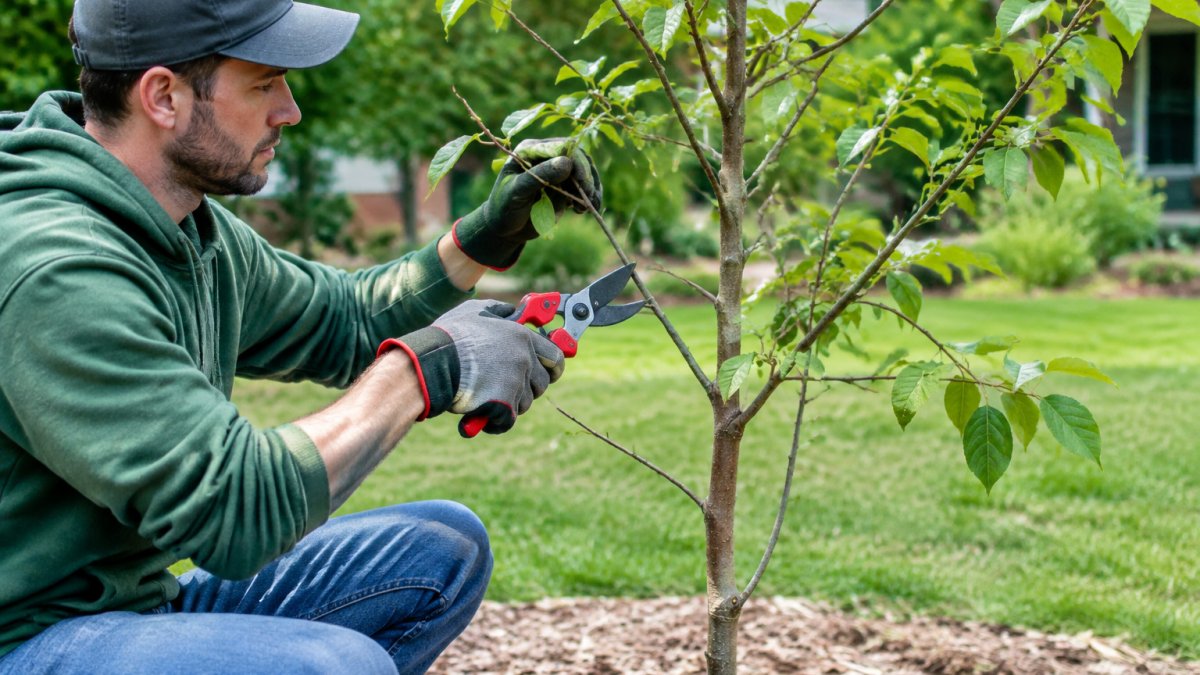
Pruning young trees is the practice of selectively removing branches in the first years after planting to shape a strong structure that lasts for decades. Homeowners across North Miami are often told the same thing: the first five years decide the next fifty.
A young tree that never gets trained grows into a tangle. Branches cross, rub, and split. Wind finds the weak forks first. That matters in South Florida, where summer storms test every limb.
Here is the part most guides skip. Pruning young trees for healthy growth is not about cutting things off. It is about choosing what stays. A well-trained tree develops one strong main trunk, called the central leader, plus evenly spaced scaffold branches that carry the canopy.
Do the work early and you spend minutes per tree. Wait ten years and you spend hours, or you pay for storm cleanup.
University of Florida IFAS tree pruning guidance
If you also want to guard new plantings against wind, these steps to protect young trees from high winds are worth a read before the season turns.
How to Prune Young Trees: A Step-by-Step Guide
Start structural pruning the first dormant season after planting, and repeat every one to three years. In North Miami's warm climate, "dormant" is loose, the practical window is late winter into early spring, before the summer storm build. Young trees respond fast to small, correct cuts, so the goal is a short visit with a clear decision sequence, not a marathon session.
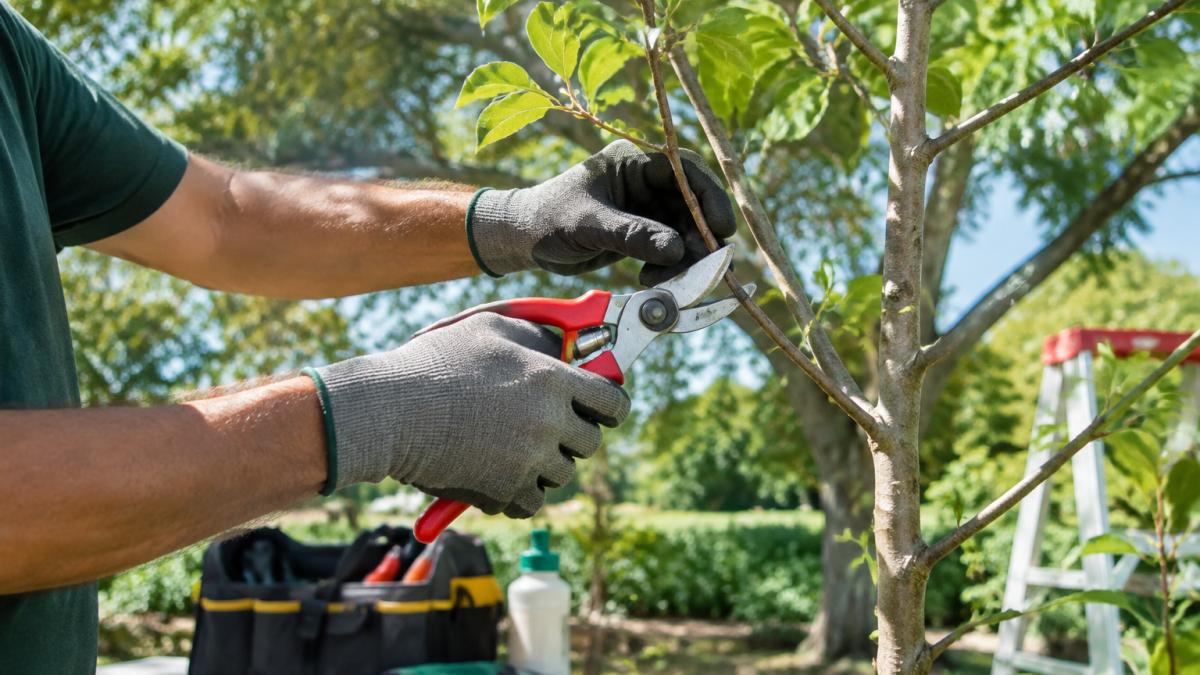
Work through this order every time:
- Walk around the tree first. Pick your best leader before you touch a tool. Look up the trunk from four sides and note which stem is straightest and strongest.
- Remove dead, damaged, or broken branches. No decision needed here. Dead wood is a hazard and a pest entry point.
- Clear competing leaders. Keep one main trunk and shorten the rest. A co-dominant stem with a narrow V-joint is the fork most likely to split in wind.
- Select scaffold branches. Choose well-spaced branches with wide angles, ideally 12 to 18 inches apart and spiraling around the trunk.
- Remove crossing or rubbing branches. Friction opens wounds that never heal cleanly.
- Step back and check the shape. Aim for balanced, not perfect. A lopsided young tree can be corrected over two or three seasons.
- Clean your tools between trees. Skip this and you spread problems from one tree to the next.
Keep total live growth removal modest in any single visit, since young trees have little energy to spare. Young trees have little energy to spare, and over-thinning pushes weak, bushy regrowth.
Species changes the sequence. Palms are not pruned like shade trees, remove only dead or dying fronds and never cut the crownshaft on a royal or foxtail palm. Live oaks and other broadleaf shade trees follow the central-leader logic above. Tropical fruit trees such as mango and avocado often grow with multiple leaders by nature, so choose the strongest and reduce the rest rather than forcing a single trunk.
Watch out: on a young tree with a very narrow crotch, shortening the weaker stem over two seasons is safer than removing it in one cut, because the tree keeps some food-producing canopy while the joint strengthens.
Establishing a Central Leader and Scaffold Branches
The central leader is the main trunk that carries the tree's height. Scaffold branches are the limbs you keep permanently, spaced along that trunk.
Look for branches with a wide angle to the trunk, closer to horizontal than upright. Wide angles form stronger joints because the wood fibers connect more continuously. Narrow, upright limbs tend to split under load.
Spacing matters too. Keep scaffold branches roughly 12 to 18 inches apart along the trunk, rotating around it like a spiral staircase. That gives every limb room for light and air, and it prevents the whorl of branches at one height that creates a weak point.
Making Proper Pruning Cuts at the Branch Collar
Every cut should land just outside the branch collar, the raised ring where the branch meets the trunk. That zone holds the tree's natural defense tissue.
Cut too far out and you leave a stub that dies back. Cut flush into the trunk and you wound the main stem. Both invite decay.
For branches too big for hand pruners, use the three-cut method: undercut first, then cut from the top, then remove the stub (Pruning in Three Steps). This stops bark from tearing down the trunk. A clean cut with a sharp bypass pruner heals faster than a crushed cut from anvil pruners or a dull blade.
Watch out: if a branch on a young tree is already thick, stop and reconsider, since a larger wound may need an arborist's judgment.
Work through this order every time you prune a young tree.
| Step | What to do |
|---|---|
| 1 | Walk around the tree and pick your best leader |
| 2 | Remove dead, damaged, or broken branches |
| 3 | Clear competing leaders, keeping one main trunk |
| 4 | Select scaffold branches with wide angles |
| 5 | Remove crossing or rubbing branches |
| 6 | Step back and check the shape |
| 7 | Clean your tools between trees |
Should I Trim Lower Branches on a Young Tree?
Yes, but slowly. Remove only the lowest, weakest limbs each year, and never strip a young trunk bare in one session.
Lower branches feed the trunk while it thickens. They also shade the bark. Take them off too early and the tree loses that support.
A simple rule: remove one or two low limbs per year, and only those that are damaged, drooping, or clearly in the way. Keep the rest until the canopy is established.
A Tree Pruning Diagram for Beginners: What Each Cut Should Look Like
Picture three cuts: the removal cut, the thinning cut, and the heading cut. Each one does a different job.
- Removal cut: takes a branch back to the trunk, just outside the collar.
- Thinning cut: takes a branch back to a side limb, keeping the natural taper.
- Heading cut: shortens a branch to a bud. Use sparingly on young trees.
The removal cut is your workhorse. Thinning cuts open light into the canopy. Heading cuts push dense regrowth, so save them for hedges, not structure.
A good beginner habit: mark the branch you plan to remove with a ribbon, step back, then decide. Most bad cuts happen fast.
Pruning Mistakes That Hurt Young Trees
The biggest mistake is removing too much at once. A young tree stripped hard may push weak, bushy regrowth or stall entirely.
Other common errors:
- Flush cuts into the trunk. These wounds do not close well.
- Leaving stubs. Stubs die back and invite pests.
- Topping the leader. This ruins the tree's form for life.
- Pruning in a heat wave. Stress stacks on stress.
- Dull or dirty tools. Torn cuts heal slowly.
Over-pruning damage often shows up months later, not days. If you have already gone too far, this guide on over-pruning damage and how to recover walks through the fix.
When to Prune in South Florida: Timing Around Storm Season
Trees in South Florida grow nearly year-round, so the "dormant season" rule needs translating rather than copying. Structural pruning is generally safest in late winter into early spring, before the summer storm build and the heaviest flush of new growth. Light corrective pruning can often happen after the spring flush settles.
Humidity and rainfall change the wound story. In South Florida's warm, wet months, fresh pruning wounds are exposed to moisture and fungal pressure for longer, and bark that stays damp heals more slowly. That is one reason late-winter pruning is favored: the tree has time to seal cuts before the rainy season.
Species timing differs. Palms are best pruned in late spring or early summer, after the year's growth has pushed, and only dead or dying fronds should come off. Live oaks and other shade trees follow the late-winter structural window.
Storm preparation is its own timing question. Structural pruning before storm season should focus on removing dead wood, reducing co-dominant stems, and clearing limbs away from the roof and power lines, not on topping or stripping the canopy.
Our storm-season guide to pruning trees during hurricane season covers timing in more detail.
Watch out: if a limb is within about 10 feet of a power line, do not prune it yourself, call the utility or a licensed arborist, because that work carries serious electrical risk.
Book an On-Site Estimate for Young Tree Pruning
A walk-through beats a phone guess every time. We look at the species, the leader, the branch angles, and how the tree sits against your house or fence.
P&P Landscaping and Tree Service is a family-owned and operated business with over two decades of experience, providing landscaping and tree care, including professional tree maintenance and sod installation, for homeowners and businesses.
Not sure how often to schedule? Read how often trees should be professionally pruned. Ready to choose a crew? See how to pick a tree trimming crew in North Miami and what a free quote involves.
Young trees only get one chance to grow a strong frame. If your yard needs a trained eye, P&P Landscaping and Tree Service brings over two decades of tree care, tailored service, and full-service landscaping to every property. We handle structural pruning, tree maintenance, and sod installation from consultation to cleanup. Get started with P&P Landscaping and Tree Service and give your young trees the start they deserve.
Frequently Asked Questions
What is the 1-2-3 rule of pruning?
The 1-2-3 rule is a simple guideline for young tree training: pick one central leader to keep the tree's main trunk dominant, keep two or three well-spaced scaffold branches in each tier, and remove only a modest share of the live canopy in a single season. Following it prevents over-pruning while building strong structure. On a newly planted tree, the focus stays on removing only dead, damaged, or crossing branches in the first year.
Should you trim lower branches on a young tree?
Sometimes, but not all at once. Lower branches help a young tree thicken its trunk and store energy, so removing them too early slows establishment. Wait until the tree has been in the ground at least one full growing season, then remove only the lowest branches that are dead, damaged, or below your desired clearance. Trim lower branches gradually over several seasons rather than stripping the trunk in one pass.
What months should you not trim trees?
Avoid heavy pruning in early spring when buds are swelling and new growth is emerging, since the tree is spending energy on that flush. In South Florida, also hold off on major cuts right before hurricane season peaks, because fresh wounds and open structure can invite problems during storms. Light removal of dead or damaged wood is fine any time of year. For structural pruning, late winter or early summer after the spring flush is generally safer.
What are common young tree pruning mistakes?
The most common pruning mistakes are removing too much live canopy at once, leaving stub cuts instead of cutting at the branch collar, and topping the central leader. Others include pruning at the wrong time of year, using dull tools that tear bark, and stripping lower branches before the trunk has thickened. Each of these sets back establishment and can leave the tree with weak, poorly spaced limbs that fail in storms.