 How-to
Who Pays for Tree Removal After a Hurricane?
Last Updated: November 20, 2026
Quick Summary
Your homeowners insurance usually pays for tree removal after a hurricane only when the fallen tree hits a covered structure, like your house, roof, shed, or fence. If the tree lands in your open yard, you typically pay out of pocket because insurers treat it as yard maintenance, not a claim.
- The tree owner is generally not liable for a neighbor's fallen tree unless negligence is proven.
- Most policies include a debris-removal limit that caps what the insurer pays to haul away branches and trunks.
- Insurers usually treat removal of a leaning tree that has not fallen as prevention, not damage, so no payout.
- Ownership of a public tree usually follows the trunk's location at ground level, not the canopy.
- Photograph the fallen tree and damage from several angles before anything is moved or hauled away.
Table of Contents
- The Short Answer: Coverage Depends on What the Tree Hit
- How Homeowners Insurance Tree Removal After Storm Works
- Who Pays When a Neighbor's Tree Falls on Your Property
- Hurricane Tree Removal Cost and What a Quote Includes
- How to Pay for Emergency Tree Removal
- Trees on Public Land, Rights-of-Way, and Shared Boundaries
- Filing Your Claim: Documentation, Adjusters, and Denials
- Book an On-Site Estimate Before the Next Storm
- Frequently Asked Questions
The Short Answer: Coverage Depends on What the Tree Hit
The short answer to who pays for tree removal after hurricane damage is this: your homeowners insurance usually covers removal only when the fallen tree hits a covered structure, like your house or fence. If the tree lands in your open yard, you typically pay out of pocket.
That single rule decides most claims. It also surprises a lot of South Florida homeowners after every storm.
Storm debris and insurance confusion come up every season after a hurricane.
The Florida Division of Consumer Services guide to homeowners insurance explains the structure behind these rules.
So before you call anyone, answer one question: what did the tree hit? Your answer sets the whole process in motion.
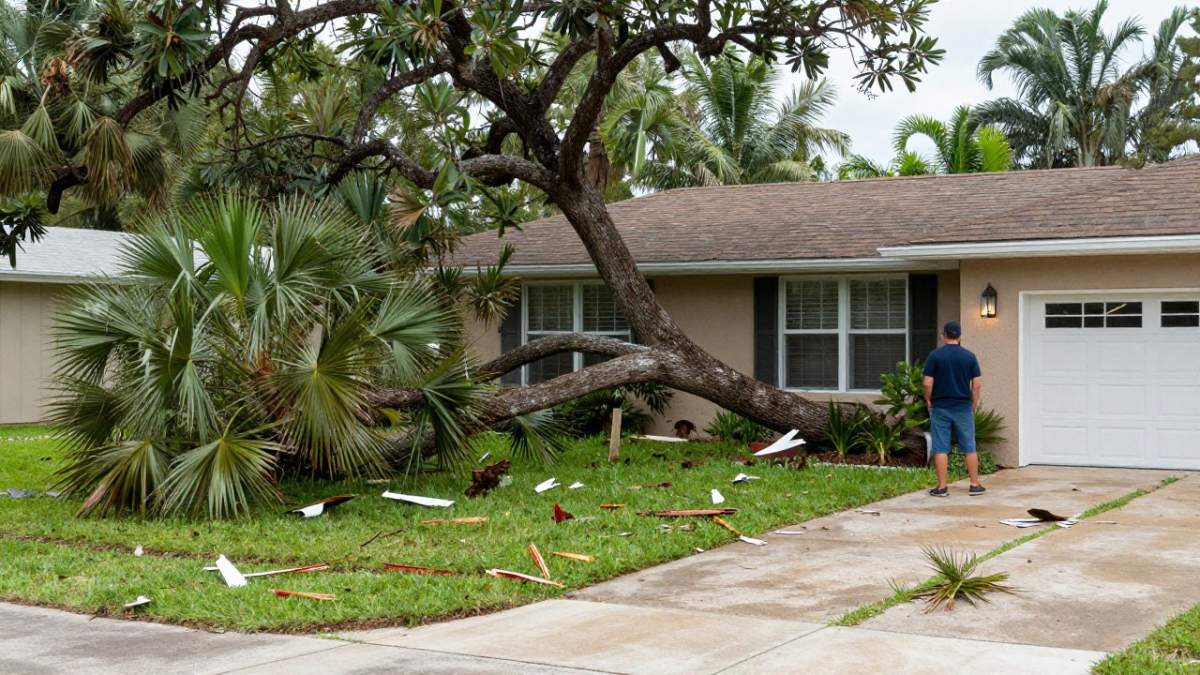
The whole claim usually turns on one question: what did the tree hit?
| Situation | Who usually pays | Note |
|---|---|---|
| Tree hits a covered structure | Homeowners insurance | House, roof, shed, or fence count as covered |
| Tree lands in open yard | You, out of pocket | Treated as yard maintenance, not a claim |
| Neighbor's tree falls on your property | Your own insurer | Tree owner generally not liable unless negligence proven |
| Leaning tree not yet fallen | You, out of pocket | Insurers treat removal as prevention, not damage |
| Tree on public land or right-of-way | City or county | Ownership usually follows trunk location at ground level |
| Boundary tree on the property line | Possibly shared | Both owners may share responsibility and must agree |
How Homeowners Insurance Tree Removal After Storm Works
Homeowners insurance tree removal after storm damage follows one core principle: the policy pays when the tree damages something it insures. If a tree has already hit your house, read what to do when a tree falls on your house for immediate next steps on safety and cleanup. Your dwelling, your roof, your shed, your fence. Those count as covered structures.
A tree that falls on open grass? That is yard maintenance, not a claim.
Covered Perils, Exclusions, and Your Deductible
Wind is a covered peril in most standard policies. So a tree blown over by a hurricane usually triggers coverage, but only for the damage it caused.
Watch out: flood damage often sits in a separate policy through the National Flood Insurance Program, so a tree felled by storm surge may not be covered the same way. Read your exclusions before you assume.
Your deductible also applies. Hurricane deductibles in Florida may be set as a percentage of dwelling coverage, so check your policy for the exact amount.
Debris Removal Limits and Leaning Trees
Most policies include a debris-removal limit. This caps what the insurer pays to haul away branches and trunks. Once you hit that limit, the rest is yours.
A leaning tree is a different story. If it has not fallen, most insurers treat removal as prevention, not damage. That usually means no payout. A hazardous tree you remove before it drops is often an out-of-pocket cost.
Who Pays When a Neighbor's Tree Falls on Your Property
Here is the rule that starts the most arguments on the block: in Florida, the tree owner is generally not responsible for a fallen tree that damages a neighbor's property, unless negligence is proven.
Negligence means the neighbor knew the tree was dead, diseased, or hazardous and did nothing. Proving that is hard. Photos, arborist reports, and prior written complaints help.
So who pays when a neighbor's tree falls on your property? Usually your own insurer, through your own policy. You file the claim, pay your deductible, and let your carrier handle it.
For a deeper look at how insurers treat these cases, read our guide on whether hurricane-damaged trees are covered by insurance.
A boundary tree, one growing on the property line, gets murkier. Ownership can be shared, and so can responsibility. Document everything and talk to your neighbor early.
Hurricane Tree Removal Cost and What a Quote Includes
Hurricane tree removal cost depends on the tree, not a flat rate. Size, location, access, and whether the tree hit a structure all change the price.
A fair quote should spell out:
- The scope of work and tree count
- Equipment needed, like cranes or rigging
- Debris hauling and disposal
- Stump grinding, if included
- Emergency or after-hours fees
Watch out: a quote that only lists a total, with no breakdown, is a red flag. Ask what happens if the job takes longer than expected.
For local benchmarks, see our breakdown of professional tree removal in Miami-Dade costs so you can sanity-check any number you hear.
How to Pay for Emergency Tree Removal
Emergency removal rarely waits for a claims adjuster. Most homeowners pay the crew up front, then get reimbursed by insurance.
Here is how to manage the money side:
- Call your insurer first. Open the claim before work starts when it is safe to wait.
- Ask about direct pay. Some carriers pay contractors directly for covered work.
- Keep every receipt. Itemized invoices speed up reimbursement.
- Check disaster assistance. Federal aid may be available in a declared disaster, but it is not a substitute for insurance.
- Document before and after. Photos protect your claim.
Never sign a blank contract or pay full cash upfront to an unknown crew that knocks on your door after a storm.
Trees on Public Land, Rights-of-Way, and Shared Boundaries
A tree on public land is generally the city's or county's responsibility, not yours. Trees in the public right-of-way, in medians, or on park property generally fall under local jurisdiction.
Start by confirming ownership before you hire anyone. A common pattern is that residents assume a tree is theirs because it leans over their yard, when the trunk is actually in the right-of-way. Ownership usually follows the trunk's location at ground level, not the canopy.
Do not cut or remove a tree on public land yourself, even if a limb blocks your view or drops debris in your yard. Removing public trees without authorization may expose you to penalties. If a public tree is leaning, split, or hung up on a wire, report it and let the responsible agency schedule the work.
Watch out: downed power lines and trees tangled in lines are utility hazards, not landscaping jobs. Stay clear, keep others away, and call Florida Power & Light (FPL) or your utility provider before any crew approaches.
Shared boundary trees are trickier. If a tree straddles the property line, both owners may share responsibility, and both may need to agree before removal. Get the ownership straight before you split a bill, and put any agreement in writing.
For trees on your own lot, our Miami landscaping and tree service team handles removal, trimming, and cleanup within 20 miles of our North Miami base. For public trees, start with the city or county, not a contractor.
Filing Your Claim: Documentation, Adjusters, and Denials
A strong claim starts before anything moves. Photograph the fallen tree, the damage, and the surrounding area from several angles, and include wide shots that show the tree in relation to the house, fence, or other structure. Adjusters use those wide shots to confirm the tree actually struck a covered structure, which is the trigger for most removal coverage.
Then follow this order:
- Photograph all damage from several angles, including close-ups of impact points
- Keep damaged items and debris in place until the adjuster sees them, unless they block access or pose a safety hazard
- Save receipts for emergency work, temporary repairs, and lodging
- Get a written, itemized removal quote that separates cutting, hauling, stump grinding, and disposal
- Meet the adjuster on site if you can, and walk the property together
A practical sequence after the storm looks like this: check for immediate hazards (downed lines, gas, unstable trees), identify where the tree was rooted, determine what it damaged, open the claim with your insurer, then arrange removal. If emergency removal cannot wait, tell your insurer before work starts when it is safe to do so, document the condition first, and keep the itemized invoice.
Watch out: disposing of the tree before the adjuster inspects it can weaken your claim. If a crew must haul debris for safety or access, photograph and video the pile first, note the date and time, and keep the disposal receipt.
If your claim is denied, ask for the reason in writing. Then escalate. You can request a re-inspection, file a complaint with the Florida Department of Financial Services, or consider hiring a licensed public adjuster. The Insurance Information Institute's guide to filing claims walks through the appeal process step by step.
For local benchmarks on what removal should cost before you submit a quote, see our breakdown of professional tree removal in Miami-Dade costs.
Book an On-Site Estimate Before the Next Storm
The best time to sort out tree risk is before hurricane season, not after. A leaning tree or a dead limb is cheaper to remove now than to clean up later.
Book an on-site estimate with P&P Landscaping and Tree Service to review your trees before a storm.
Not sure what to expect when you request a quote? Read our guide on what to expect from a professional tree removal quote.
Ready to protect your home before the next storm? Get started with P&P Landscaping and Tree Service and book an on-site estimate today. Our family-owned team brings over two decades of experience to tree care and landscaping projects.
Storm season does not wait, and neither should your tree plan. P&P Landscaping and Tree Service offers free on-site estimates, expert tree removal, and full cleanup for homes and businesses across Miami-Dade and Broward. Get started with P&P Landscaping and Tree Service and keep your property safe before the next hurricane.
Frequently Asked Questions
Does homeowners insurance cover tree cleanup after a storm?
It usually does when the fallen tree hit a covered structure like your house, garage, fence, or shed. In that case, many policies pay for tree removal up to a debris-removal limit set in your policy. If the tree fell in the open yard and damaged nothing, many policies pay little or nothing. Check your declarations page for your debris-removal limit before you assume you are covered.
Who pays if a neighbor's tree falls on my property during a hurricane?
In most cases, your own homeowners insurance pays for damage to your home, and the neighbor is not automatically responsible. Fault usually requires proof of negligence, such as a dead or diseased tree the owner knew about and ignored. If a professional had warned the neighbor in writing and nothing was done, that documentation can support a claim against them. Otherwise, file with your insurer and let them handle any recovery.
Does FEMA reimburse for tree removal?
Federal assistance programs generally focus on making a home safe and habitable rather than general yard cleanup. Check with local emergency management about debris pickup schedules after a declared disaster. If your area is declared a disaster, check with local emergency management for debris pickup schedules rather than expecting federal reimbursement.
Will homeowners insurance cover preventive tree removal before a hurricane?
Rarely. Standard policies exclude removal of trees that have not yet fallen or damaged anything, because that is considered maintenance. Some insurers offer limited coverage for hazardous tree removal if a certified arborist documents the risk in advance, but you usually pay out of pocket. The practical move is to get a written hazard assessment and remove risky trees before storm season, when removal is far cheaper than emergency work.