 How-to
7 Rules for Fertilizing Newly Installed Sod
Last Updated: November 16, 2026
Quick Summary
Wait two to four weeks after installation before applying a full new sod fertilizer dose, though a light starter application at or just before installation is fine. A heavy feeding during the first two weeks risks fertilizer burn on tender roots, so water only until roots resist a gentle tug.
- Starter fertilizer is a high-phosphorus blend that pushes root growth rather than top growth.
- New sod gets roughly half the established-lawn rate for its first feeding.
- Calibrate the spreader on a test strip before applying any product to the lawn.
- Water in the morning, since evening watering invites fungus in humid climates.
- Do not fertilize when heavy rain is forecast within 24 hours.
Table of Contents
- Why New Sod Fails Without the Right Fertilizer Timing
- When to Fertilize New Sod: The First Four Weeks
- The Best Fertilizer for New Sod in South Florida
- Is 10-10-10 Fertilizer for New Sod a Safe Choice?
- Calculating Fertilizer Rate and Spreading It Evenly
- Watering New Sod Without Washing Out the Fertilizer
- Your New Sod Care Timeline from Week One to Month Three
- Florida Fertilizer Rules and Rainy-Season Precautions
- Frequently Asked Questions
Why New Sod Fails Without the Right Fertilizer Timing
Most new sod dies from kindness, not neglect, and the right new sod fertilizer timing is the fix.
New sod arrives with a thin layer of soil still clinging to its roots. Those roots are stressed from being cut, lifted, and trucked across South Florida.
Fertilizer is best understood as a support tool rather than a rescue tool. It is not.
If your new sod is already yellowing, read our guide to 7 reasons new sod turns yellow and how to fix it before you touch a fertilizer bag.
When to Fertilize New Sod: The First Four Weeks
The short answer: wait two to four weeks after installation before applying a full fertilizer dose. A light starter application at or just before installation is fine, but a heavy feeding during the first two weeks risks fertilizer burn on tender roots.
Fertilizer burn is root damage caused by too much soluble salt sitting against young roots. It shows up as browning edges and stalled growth, and it looks almost identical to drought stress.
Here is the practical sequence:
- Day 0 (installation): Light starter fertilizer worked into the soil, or none at all if the sod was grown in rich soil.
- Weeks 1-2: Water only. No granular fertilizer.
- Weeks 2-4: First light feeding, once roots resist a gentle tug.
Starter Fertilizer at Installation vs. Waiting
Starter fertilizer is a high-phosphorus blend designed to push root growth rather than top growth. Phosphorus does the underground work, which is exactly what new sod needs.
Apply it before or during installation if your soil test shows low phosphorus. If you skip it, waiting until week three is perfectly safe.
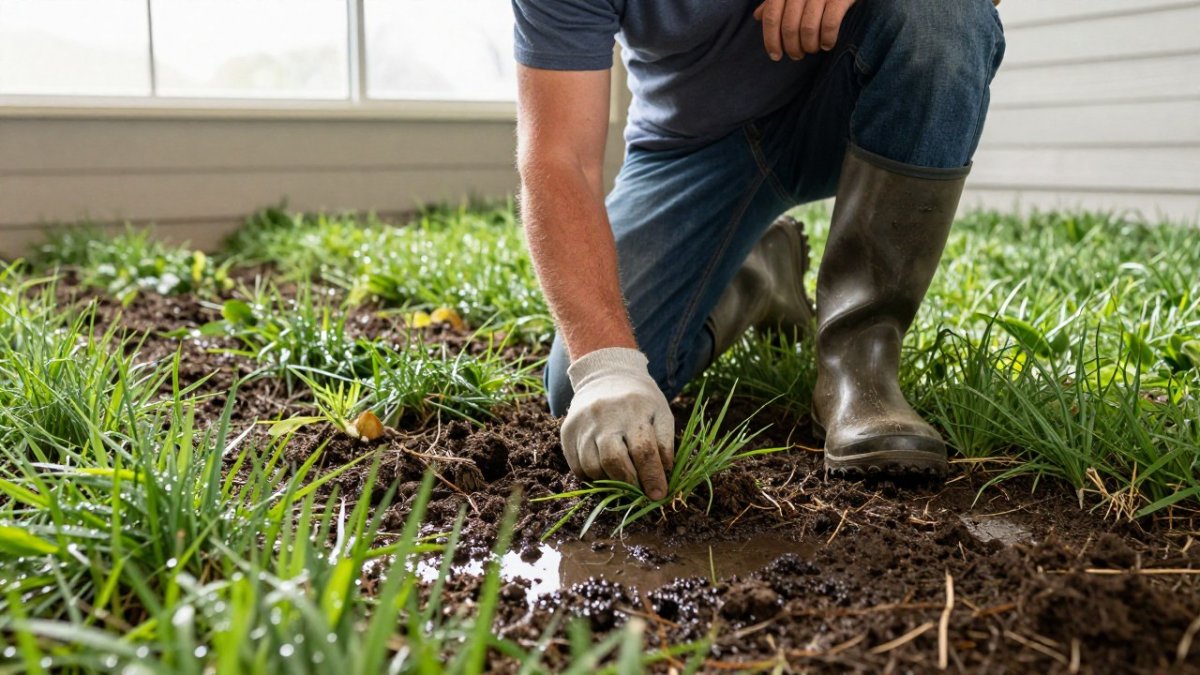
A simple test tells you whether roots are ready: grab a corner of sod and pull gently.
The Best Fertilizer for New Sod in South Florida
The best new sod fertilizer is a balanced or slightly phosphorus-heavy blend with slow-release nitrogen, matched to your grass species and your soil test.
Two reasons. First, our sandy soil drains fast and holds few nutrients, so slow-release formulas feed steadily instead of flushing away. Second, heavy summer rain leaches nitrogen quickly, and a slow-release granule keeps working through the wet season.
Look for these on the label:
- Slow-release nitrogen: feeds over weeks, not days
- Phosphorus: supports root establishment
- Potassium: helps the grass handle heat and stress
Matching Fertilizer to St. Augustine, Bahia, and Zoysia
Grass type changes the plan. St. Augustinegrass is the most common choice in North Miami yards, and it responds well to a balanced blend with moderate nitrogen. Bahiagrass is tougher and tolerates leaner soil, so a lighter rate works fine. Zoysiagrass is slower to establish and benefits from patience plus a gentle, balanced feeding.
Bermudagrass is rarely the right pick for shaded South Florida lots, but where it is used, it wants a bit more nitrogen once established. Skip heavy feeding on any species until the roots hold.
Is 10-10-10 Fertilizer for New Sod a Safe Choice?
Yes, 10-10-10 fertilizer for new sod is safe when applied at a light rate after roots establish. It is a balanced blend, meaning equal parts nitrogen, phosphorus, and potassium, and it covers all three major nutrients without pushing top growth too hard.
The catch is rate. 10-10-10 is not gentle by default. Applied heavily on young sod, the nitrogen releases fast enough to burn roots. Applied lightly at week three or four, it is one of the simplest choices available at any garden center.
Calculating Fertilizer Rate and Spreading It Evenly
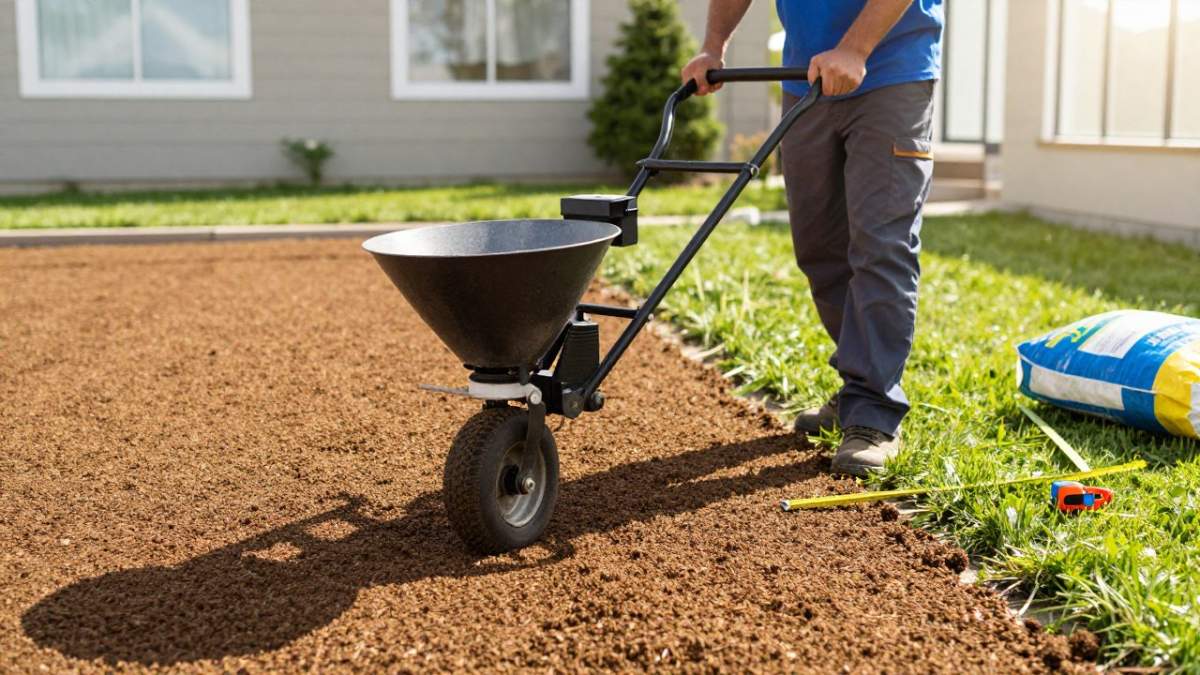
The label rate is your starting point, not your answer. To calculate fertilizer rate, measure your lawn area in square feet, then follow the bag's coverage rate for new sod, usually half the rate listed for established lawns.
Step 1: Measure the lawn in square feet
Measure length times width in feet. Break odd shapes into rectangles and add them. A typical North Miami front yard runs about 2,500 square feet; a full lot with front, back, and side yards often lands between 5,000 and 8,000 square feet. Write the number down, every calculation below depends on it.
Step 2: Read the label for two numbers
Every fertilizer bag lists a guaranteed analysis (the N-P-K percentages) and an application rate, usually expressed as pounds of product per 1,000 square feet. For example, a bag of 10-10-10 may list 1 pound of product per 1,000 square feet for established turf. That label rate is for a mature lawn, not new sod.
Step 3: Halve the rate for new sod
New sod gets roughly half the established-lawn rate for its first feeding. Using the example above, that is 0.5 pound of 10-10-10 per 1,000 square feet. On a 2,500-square-foot lawn, that works out to 1.25 pounds of product total for the first feeding. Weigh it on a kitchen scale or a luggage scale, guessing by the handful is how burn patches start.
Step 4: Check the nitrogen dose against the grass
Divide the product weight by the nitrogen percentage to see how much actual nitrogen you are applying. In the example, 1.25 pounds of 10-10-10 delivers about 0.125 pound of actual nitrogen across 2,500 square feet, a gentle starter dose. If your bag is a high-nitrogen blend like 24-0-11, the same product weight delivers more than twice the nitrogen, which is why the label rate, not the bag size, controls the dose.
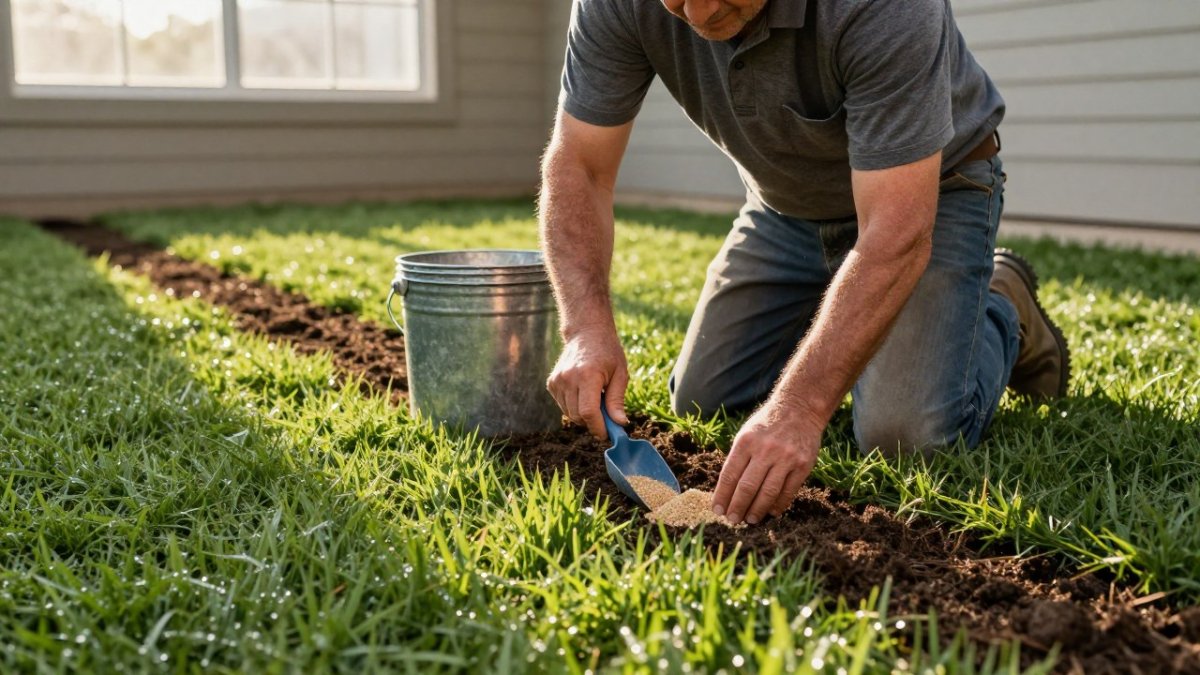
Step 5: Calibrate the spreader before you touch the lawn
Spreader calibration is the step almost everyone skips, and it is the step that prevents stripes, burn patches, and wasted product. The standard method:
- Mark off a test strip, for example 10 feet by 50 feet (500 square feet).
- Fill the spreader with a known weight of product, say 2 pounds.
- Set the dial to the manufacturer's suggested setting for your product rate.
- Walk the strip at your normal pace, then weigh what is left in the hopper.
- If you used more or less than your target for 500 square feet, adjust the dial and repeat until output matches.
Ten minutes with a tape measure and a scale saves a lawn. Keep a note of the final dial setting and your walking pace so the next application matches.
Step 6: Split the application and overlap the passes
Apply half the dose walking north-south, then half walking east-west. Overlapping passes at half rate evens out the streaks a broadcast spreader leaves at the edges of its pattern.
Watch out: a spreader dial setting from a different product or a different spreader brand will not match your bag, always calibrate with the product you are actually applying, not the one the neighbor used.
Watering New Sod Without Washing Out the Fertilizer
The balance matters. Too little water and the granules sit on dry soil without dissolving.
A workable schedule:
- Weeks 1-2: Short watering sessions two to three times daily, keeping the sod and top inch of soil moist.
- Weeks 3-4: Once daily, deeper, as roots begin to knit.
- After week 4: Two to three deep sessions per week, early morning.
Water in the morning. Evening watering leaves blades wet overnight, which invites fungus in our humid climate. If heavy rain is forecast within 24 hours of feeding, wait.
Not sure whether your watering is on track? Our guide on how to tell if new sod is getting enough water walks through the check.
Your New Sod Care Timeline from Week One to Month Three
A new sod care timeline keeps you from guessing. Here is the schedule we give every client after installation, and it works for most warm-season grasses in South Florida.
| Stage | Timing | Fertilizer | Watering | Mowing |
|---|---|---|---|---|
| Establishment | Weeks 1-2 | None, or starter at install | Light, 2-3 times daily | No |
| Root knit | Weeks 2-4 | First light feeding at week 3-4 | Once daily, deeper | No |
| Green-up | Weeks 4-6 | Follow-up feeding if color lags | 2-3 deep sessions weekly | First mow when sod holds |
| Settled | Weeks 6-12 | Normal schedule, split doses | Deep, less often | Regular height |
Mowing starts only when the sod resists a gentle pull and has grown about a third taller than its target height. For most lawns that lands around week four to six.
If you want the full root timeline, our breakdown of how long new sod takes to root covers what is happening underground each week. And when mowing day gets close, here is how to know when to mow new sod for the first time.
Florida Fertilizer Rules and Rainy-Season Precautions
Florida regulates lawn fertilizer to limit nitrogen runoff into waterways. Local fertilizer rules vary, so check the ordinance that applies to your address with your city or county before buying or applying fertilizer.
Before you buy a bag, check the current local ordinance for your address and the product label. Requirements can differ from one Florida county to another. The label should show the guaranteed analysis and whether the nitrogen is slow-release; if it does not, ask before you buy.
Rainy-season precautions that actually matter
The rainy season, roughly May through October, is the riskiest window. Three practical rules:
- Do not fertilize when heavy rain is forecast within 24 hours. Granules dissolve, nitrogen moves, and your money ends up in the storm drain.
- Split applications into smaller doses. Two half-rate feedings a few weeks apart feed the grass more evenly than one heavy dose that a downpour can wash away.
- Use slow-release nitrogen. A slow-release granule keeps working through wet weather instead of flushing out in the first storm.
Runoff carries both your money and your nutrients away. Sweep granules off driveways, sidewalks, and storm drains back onto the lawn, and never blow or hose fertilizer into the street.
If timing, rates, and rules feel like a lot to manage, our crew handles lawn service in Miami from fertilization to irrigation, along with tree trimming and material delivery within 20 miles of North Miami.
Frequently Asked Questions
Is it okay to fertilize newly laid sod right away?
Only if the installer applied a starter fertilizer at the soil prep stage, before the sod went down. If no starter was used, wait until the sod has knitted into the soil, usually two to four weeks in warm weather. Tug a corner: if it resists, roots are working and a light feeding is safe. Fertilizing loose, unrooted sod pushes top growth the roots cannot support and raises the risk of fertilizer burn.
Can you use 10-10-10 fertilizer on new sod?
Yes, at a low rate, and only after roots have started to establish. A 10-10-10 delivers equal parts nitrogen, phosphorus, and potassium, which suits South Florida's sandy soil where phosphorus leaches quickly. Apply no more than about half a pound of actual nitrogen per 1,000 square feet, water it in immediately, and keep granules off the seams where sod pieces meet. A soil test tells you whether the phosphorus is even needed.
How long should you wait to mow and fertilize new sod?
Mow once the sod has rooted enough that it will not lift under the mower, typically two to three weeks after installation. Set the blade high and cut no more than a third of the leaf height. For the first fertilizer application, wait the same two to four weeks unless a starter feed went down at installation. Rushing either step on soft, wet sod tears roots and opens the lawn to disease.
Should you fertilize new sod in the fall in North Miami?
In North Miami, warm-season grasses keep growing through fall, so a light feeding in September or early October is fine as long as the lawn is established. Switch to a lower-nitrogen formula as growth slows, and stop feeding about six weeks before the first expected cold snap. Avoid heavy nitrogen late in the year; it produces tender growth that cold weather damages.