 Ultimate guide
7 Signs It's the Best Time of Year for Crown Cleaning
Last Updated: November 18, 2026
Quick Summary
The best time of year for crown cleaning in South Florida is generally late winter to early spring, before the first strong growth flush. Heavy structural work belongs in the cooler, drier months, while major cuts should be avoided during peak summer heat and the wettest weeks.
- South Florida trees grow nearly year-round, so dormant-season advice written for cold climates does not apply.
- Light corrective cleaning can happen almost any time, but it is not for major cuts.
- Live oaks and shade trees do best with structural cleaning in late winter.
- Crown cleaning before storm season lets wind pass through the canopy instead of pushing against it.
- Topping a tree to reduce wind load does the opposite by forcing weak, fast regrowth.
Table of Contents
- Why Crown Cleaning Timing Matters More in South Florida
- The Benefits of Crown Cleaning for Tree Health
- Season by Season: The Best Time of Year for Crown Cleaning
- How to Tell Your Tree Needs Crown Cleaning
- Hurricane Preparedness Tree Trimming: Cleaning Before the Storm
- What to Expect From Tree Pruning Services in North Miami
- Crown Cleaning Mistakes That Harm Your Trees
- Book an On-Site Estimate for Crown Cleaning
- Frequently Asked Questions
Why Crown Cleaning Timing Matters More in South Florida
Crown cleaning is the selective removal of dead, diseased, crossing, and weakly attached branches from a tree's canopy, and in South Florida the timing question has a different answer than most national guides give. The single biggest mistake homeowners make is applying dormant-season advice written for cold-climate maples to tropical and subtropical trees that never truly go dormant. Trees here grow nearly year-round, so timing matters more than it does in cooler climates.
How the Subtropical Growing Cycle Changes the Rules
South Florida's growing season does not pause the way it does up north. Warm nights and steady humidity keep the vascular system active almost continuously, so trees push new growth in flushes rather than one spring burst. That changes when pruning cuts heal and when pathogens are most active. The practical takeaway: the best time of year for crown cleaning here is usually late winter into early spring, before the first strong growth flush.
The Benefits of Crown Cleaning for Tree Health
Crown cleaning can improve tree health by restoring structural integrity, increasing light penetration and air circulation through the canopy, and removing deadwood that can harbor pests and disease. When the canopy is thinned, wind can move through the crown instead of pushing against a solid wall of foliage. Removing hazardous limbs before they fail reduces risk. If you are weighing the investment, our guide on whether tree crown cleaning is worth the cost breaks down the value against the risks of waiting.
Season by Season: The Best Time of Year for Crown Cleaning
The best time of year for crown cleaning in South Florida is generally considered to be late winter to early spring. That window is not absolute. It shifts with species, storm season, and the tree's current condition, which is why a fixed calendar date is a poor substitute for reading the tree.
Dormant Season vs. Active Growing Season
Dormant-season pruning assumes the tree is resting and sap is not moving. In warm climates, many trees never fully rest, so the dormant-versus-active distinction can blur. Heavy structural work still belongs in the cooler, drier months when stress is lower and visibility through the canopy is best. Light corrective cleaning can happen almost any time, but avoid major cuts during the peak of summer heat and the wettest weeks, when open wounds and humidity invite rot.
A Species-Specific Pruning Calendar for Miami-Dade and Broward
Species matter more here than season labels. Live oaks and other shade trees do best with structural cleaning in late winter. Palms are a separate case entirely and should be handled on their own schedule, never with the same assumptions as a broadleaf tree. Fruit trees follow their own fruiting cycle. If you want to plan ahead properly, our breakdown of how often trees should be professionally pruned helps you set a realistic recurring schedule rather than guessing year to year.
Here is how the timing guidance breaks down by season and tree type.
| Timing or Tree Type | Recommendation | Note |
|---|---|---|
| Late winter to early spring | Best overall window for crown cleaning | Before the first strong growth flush |
| Cooler, drier months | Heavy structural work belongs here | Lower stress and best canopy visibility |
| Peak summer heat and wettest weeks | Avoid major cuts | Open wounds and humidity invite rot |
| Light corrective cleaning | Can happen almost any time | Not for major cuts |
| Live oaks and shade trees | Structural cleaning in late winter | Species matters more than season labels |
| Palms | Handled on their own schedule | Never same assumptions as a broadleaf tree |
| Fruit trees | Follow their own fruiting cycle | Separate from shade tree timing |
How to Tell Your Tree Needs Crown Cleaning
A tree needs crown cleaning when you can spot dead, diseased, or broken limbs in the canopy, when the crown is so dense that light barely reaches the interior, or when branches cross and rub against each other. Here is how to check:
- Look up through the canopy in daylight and note any bare branches that stay bare while the rest leafs out.
- Check for crossing branches and bark that is being rubbed raw.
- Look for fungal growth, cavities, or soft wood at branch unions.
- Watch for limbs hanging over roofs, driveways, or power lines.
- Note any branch that moves independently and weakly in wind.
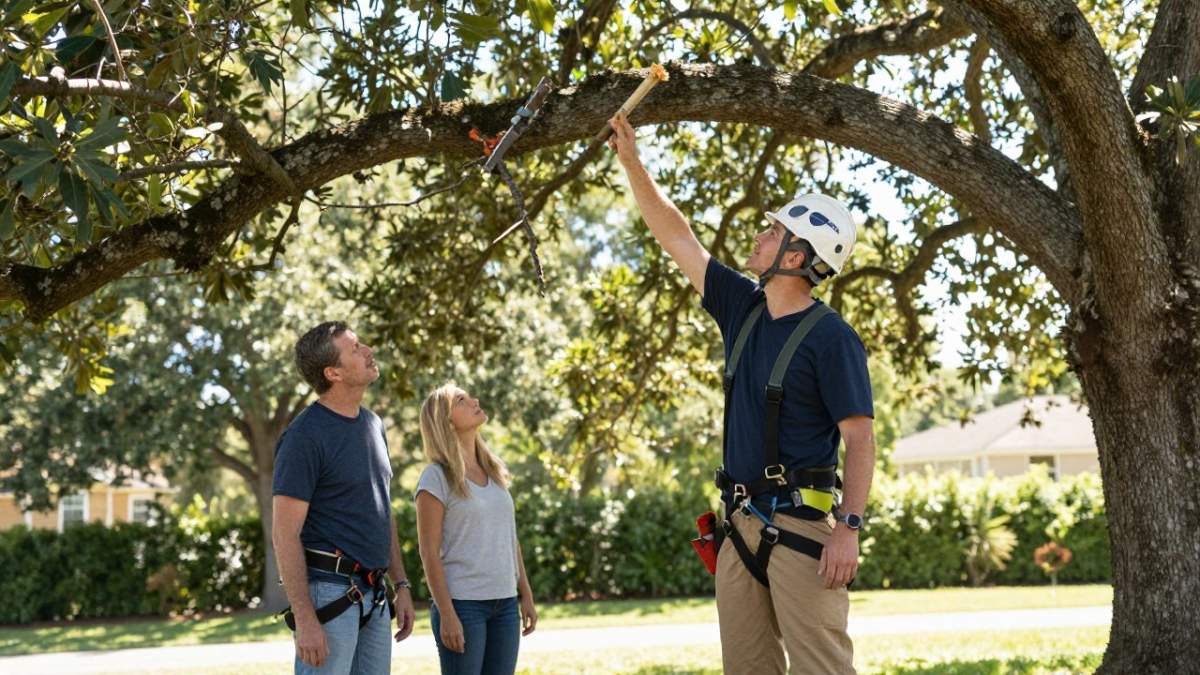
What most guides miss is that a dense green crown can hide serious structural problems. Healthy foliage on a weak limb is still a hazard.
Hurricane Preparedness Tree Trimming: Cleaning Before the Storm
Hurricane preparedness tree trimming is the practice of reducing a canopy's wind resistance before storm season, and crown cleaning is its foundation. A tree with excessive foliage density acts like a sail. Selective branch removal lets wind pass through, lowering the load on trunks and major limbs. The right time to do this work is well before hurricane season, not the week a storm is named.
Why Crown Cleaning Reduces Wind Load
Wind load on a tree is a function of canopy surface area, branch attachment strength, and how much the crown can flex. A dense, unthinned crown presents a solid wall; selective removal of dead, crossing, and weakly attached limbs opens gaps that let wind pass through instead of pushing the whole structure. The effect is not cosmetic. Limbs that are already dead or weakly attached are typically the first to fail in a storm, which is the wood crown cleaning targets. Cleaning also improves visibility through the canopy, so a crew can spot a cracked union or included bark before it becomes a projectile.
Species-Specific Storm Vulnerabilities in South Florida
Not every tree fails the same way, and the pre-storm inspection should reflect that:
- Live oaks are among the most wind-resistant shade trees in the region, but long horizontal limbs and old wound cavities are the common failure points. Clean deadwood and reduce long lever arms before the season.
- Gumbo limbo is fast-growing and soft-wooded; it sheds limbs readily in high wind. Thin selectively rather than shearing, and remove crossing branches that rub wounds open.
- Ficus and strangler fig carry dense canopies and heavy lateral limbs; included bark at unions is a recurring weak point. Crown cleaning should target those unions, not just the outer shell.
- Palms are a separate case. Dead fronds and fruit stalks become airborne debris; remove only dead or dying material and never over-prune green fronds, which weakens the palm and reduces its ability to recover.
- Bald cypress is deciduous and sheds fine material; the pre-storm priority is deadwood removal, not thinning live growth.
A Pre-Season Inspection Cadence
If a tree shows a cavity, a cracked union, or a lean that has changed since last year, that is a hazard assessment, not routine cleaning, and it should be handled before the season rather than during it.
What Not to Do
Watch out: topping a tree to "reduce wind load" does the opposite. Topping forces weak, fast regrowth attached at the cut, and that regrowth fails in the next storm. Lion-tailing, stripping interior growth and leaving heavy tufts at the branch ends, has the same effect, shifting weight to the tips and reducing the tree's ability to damp wind. The goal is a cleaner, more open crown with sound attachments, not a shorter one. Our tree trimming for storm safety guide walks through the practical steps, and it pairs naturally with crown cleaning done in the late-winter window.
What to Expect From Tree Pruning Services in North Miami
Tree pruning services in North Miami should follow recognized arboriculture standards, use proper pruning cuts at the branch collar, and leave you with a cleaner, safer crown rather than a stripped one. Expect an on-site assessment first. Reputable work follows recognized pruning standards, and a good crew explains which limbs are coming off and why before anyone climbs. Pricing depends on tree size, access, and how much deadwood is present, so ask for an on-site estimate rather than a phone number. If you want to understand the standard behind the work, the ANSI A300 pruning standards overview explains what compliant pruning looks like.
Crown Cleaning Mistakes That Harm Your Trees
A common crown cleaning mistake is over-pruning, removing more live growth than the tree can afford to lose. Other common errors: making flush cuts that destroy the branch collar and slow wound closure, leaving stubs that decay back into the trunk, and lion-tailing, which strips interior growth and leaves heavy tufts at the branch ends. Topping is the worst of all. Our guide on how over-pruning damages trees and how to recover covers the warning signs and the recovery path in detail.
Book an On-Site Estimate for Crown Cleaning
An on-site estimate lets you have your canopy assessed before you commit to a schedule. As a family-owned and operated business with over two decades of experience, we provide both landscaping and tree care, and tailor our services to each property. If you are searching for crown cleaning near me, request an on-site estimate. Book an on-site estimate and we will assess your canopy and schedule the work around your trees, not the calendar.
Your trees will not tell you when a limb is about to fail, but a trained assessment will. P&P Landscaping and Tree Service offers expert tree care, tailored service plans, and seamless project execution from first consultation to final cleanup, all backed by a family-owned team with over two decades in South Florida. Get started with P&P Landscaping and Tree Service and give your canopy the care that keeps it standing through storm season and beyond.
Frequently Asked Questions
What is the best time of year for crown cleaning in South Florida?
Late winter into early spring is generally considered a favorable window for crown cleaning in South Florida for many species.
How does crown cleaning differ from crown reduction?
Crown cleaning removes only dead, dying, diseased, or crossing branches, leaving the tree's overall size and shape intact. Crown reduction cuts back live limbs to shrink the canopy, which is a more aggressive technique. Cleaning focuses on structural integrity and safety, while reduction changes the tree's form and is typically reserved for specific clearance or size problems.
Can you perform crown cleaning during hurricane season in North Miami?
Light cleaning that removes deadwood and weak limbs can be considered during hurricane season. Heavy live-wood pruning is generally best avoided right before a storm.
What are the signs that a tree needs crown cleaning?
Look for dead branches with no leaves, cracked or hanging limbs, branches rubbing against each other, and a canopy so dense that little light reaches the grass below. Fungal growth, cavities, or peeling bark on upper limbs also signal trouble. If you see these signs, a qualified arborist can assess whether selective branch removal is needed.