 how-to
7 Emergency Tree Removal Steps After a Storm
Last Updated: November 1, 2026
Quick Summary
Emergency tree removal starts with securing the area and photographing the damage from at least three angles before anything moves. Then call your utility company if a line is down and a licensed tree service, and call your insurer before you sign anything.
- Keep people and pets clear of the canopy and root zone, since a fallen tree is rarely stable.
- Photograph the tree from at least three angles, including one wide shot, before cleanup starts.
- Ask for a certificate of insurance sent directly from the insurer, covering liability and workers' compensation.
- Do not discard the wood or debris until the adjuster has seen it or released it.
- Never cut a tree under tension, because a pinned limb can release with enormous force.
Table of Contents
- When a Downed Tree Can't Wait Until Morning
- Step 1: Secure the Area and Document the Damage
- Step 2: Call for Emergency Tree Removal Services After a Storm
- What Storm Damage Tree Cleanup Cost Really Depends On
- Hiring Local Tree Removal Experts: What to Check Before You Sign
- How to File an Insurance Claim for a Fallen Tree
- Mistakes That Turn a Bad Storm Into a Costly One
- Book an On-Site Estimate With P&P Landscaping and Tree Service
- Frequently Asked Questions
When a Downed Tree Can't Wait Until Morning
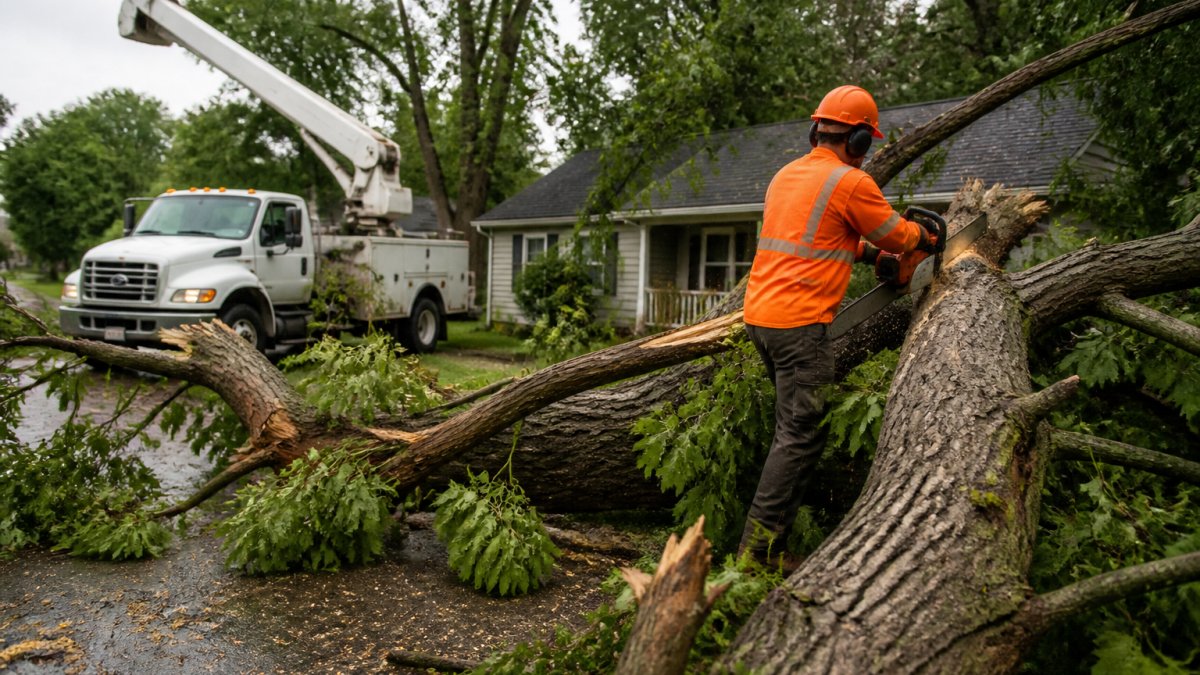
A downed tree that blocks a driveway, leans on a roofline, or rests on a fence line is a safety problem first and a cleanup problem second. Emergency tree removal services after storm events exist for exactly this situation: a tree that has already failed and now threatens people, structures, or access.
Chainsaws come out, ladders go up, and someone tries to drag a limb that is still under tension. Below, the steps are presented in order, from securing the scene to filing the claim.
One more thing worth knowing before you read on: your insurance company will care far more about your photos than your story. That single fact should shape everything you do in the first thirty minutes.
Step 1: Secure the Area and Document the Damage
Keep people and pets away from the tree before you touch anything. A fallen tree is rarely stable. Root plates can shift, limbs under compression can spring, and a trunk resting on a fence can roll without warning.
If the tree hit your house, that changes the order of operations. Structural damage needs its own response before tree work begins, and our guide on what to do when a tree falls on your house covers the immediate sequence.
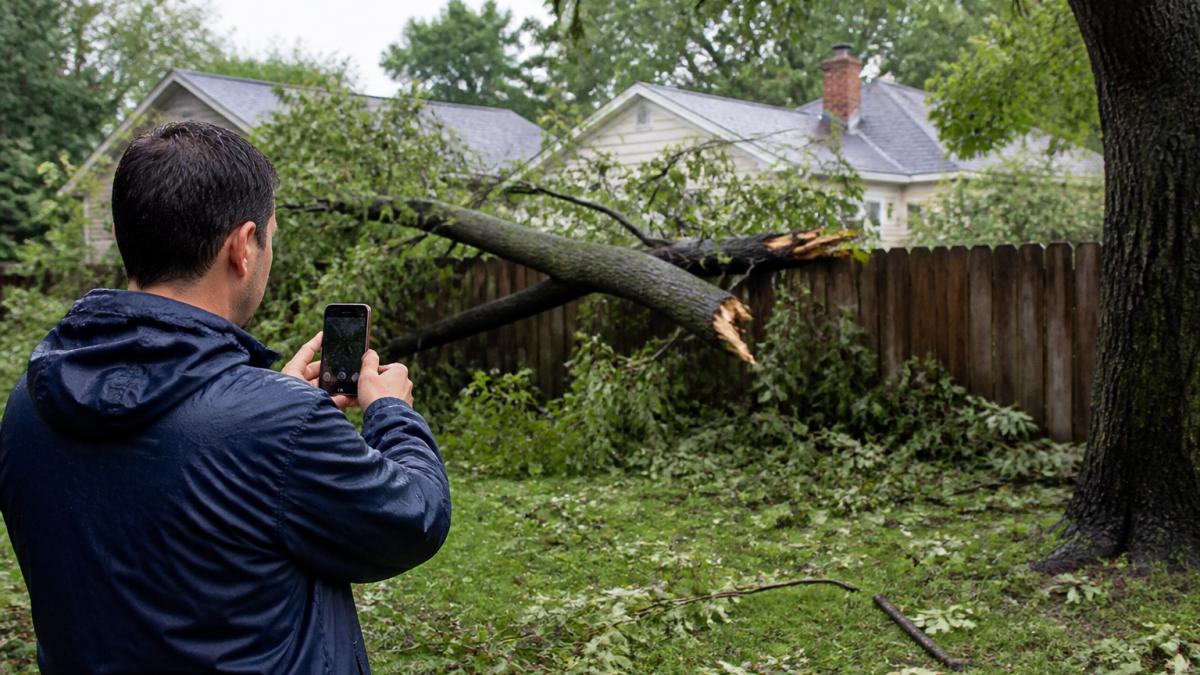
What to Photograph Before Anything Moves
Photograph the tree from at least three angles, including one wide shot showing the whole tree in relation to the house, fence, or driveway. Then photograph:
- The point where the tree meets the ground, including the root plate
- Any damage to structures, vehicles, fences, or utilities
- Close-ups of broken limbs and cracked trunks
- The surrounding yard, so debris volume is visible
Take the photos before cleanup starts. Adjusters work from documentation, and a tidy yard with no "before" shots is a harder claim to support. Moving debris before photographing it is a common mistake, and it can make an insurance claim harder to support.
Here is what to photograph before anything moves.
| What to photograph | Detail |
|---|---|
| The tree | At least three angles, including one wide shot |
| Tree meets ground | Include the root plate |
| Damage | Structures, vehicles, fences, or utilities |
| Broken limbs and cracked trunks | Close-ups |
| Surrounding yard | So debris volume is visible |
Step 2: Call for Emergency Tree Removal Services After a Storm
Call a professional before you call your insurer, and call your insurer before you sign anything. Emergency tree removal is the work of getting a failed tree off a structure or out of a roadway safely, and it requires equipment most homeowners do not own: a bucket truck, rigging, and the ability to work around downed power lines without becoming a statistic.
Two calls matter most in the first hour:
- Your utility company, if any line is down or the tree is near one. Never approach a downed line, and never assume it is dead.
- A licensed tree service that handles storm emergencies and can give you a realistic arrival window.
When you call, describe the situation plainly: tree size, what it is resting on, whether any structure is involved, and whether power lines are nearby. That information determines what equipment gets dispatched. If you are searching for "emergency tree removal near me" in the middle of the night, prioritize services that answer the phone and can tell you when a crew will actually arrive.
What Storm Damage Tree Cleanup Cost Really Depends On
Storm damage tree cleanup cost is driven by access, size, and what the tree is sitting on, not by a flat rate. A tree that falls in an open yard is a different job from one resting on a roof, and pricing reflects that difference. The variables that move the number most:
- Tree size and species. A mature oak with a wide canopy takes more rigging and more disposal than a smaller ornamental.
- Position. Trees near structures, fences, or power lines require controlled sectioning rather than a straight drop.
- Access. A backyard tree with no gate wide enough for equipment means every piece comes out by hand.
- Debris volume. Hauling and disposal scale with the amount of material removed.
- Urgency. After-hours and storm-response calls carry different scheduling than routine work.
Storm work pricing is usually not quoted over the phone, because a reliable number requires seeing the tree. Ask any provider for an on-site assessment and a written scope that separates removal from stump grinding and debris hauling, because those are frequently quoted separately.
Hiring Local Tree Removal Experts: What to Check Before You Sign
Hiring local tree removal experts comes down to three checks: licensing, insurance, and a written scope. Everything else is secondary. Storm season brings out out-of-town crews and unlicensed operators who knock on doors after a storm, and the homeowner carries the risk when something goes wrong.
Ask every crew the same questions before work begins:
- Are you licensed to operate in this county?
- Can you show a certificate of insurance for general liability and workers' compensation?
- Who is the crew leader on site, and who do I call if something changes?
- Is debris hauling included, and where does the material go?
- What happens if the work damages my fence, driveway, or lawn?
Our guide on questions to ask before hiring tree removal experts expands each of these into what a good answer sounds like. A legitimate crew answers without hesitation. A crew that dodges the insurance question is telling you something.
Licensing, Insurance, and the Paperwork That Protects You
Get the certificate of insurance sent directly from the insurer, not handed to you as a photocopy. Confirm the policy is current and that it names both general liability and workers' compensation. If an uninsured worker is injured on your property, the exposure can land on you.
Then read the scope of work before signing. It should list the trees being removed, whether stumps are ground, who hauls the debris, and the payment terms. Watch out: a one-line estimate scribbled on a business card is not a contract, and it gives you nothing to stand on if the job goes sideways.
How to File an Insurance Claim for a Fallen Tree
Start the claim with your photos and a written description of the damage, then let the adjuster tell you what your policy covers. Whether hurricane-damaged trees are covered at all is a question worth settling before you start the paperwork, and our breakdown of hurricane-damaged tree insurance coverage explains how insurers typically treat these claims.
The sequence that works:
- Photograph everything before cleanup.
- Call your insurer and open the claim. Get a claim number.
- Keep every receipt and every written estimate.
- Do not discard the wood or debris until the adjuster has seen it or released it.
- Document any emergency work separately, since many policies treat emergency removal differently from routine removal.
The Florida Division of Emergency Management publishes storm recovery guidance that is worth reading before hurricane season, and the National Association of Insurance Commissioners maintains consumer resources on how homeowners claims are handled. Neither replaces your own policy language, but both help you ask better questions.
Mistakes That Turn a Bad Storm Into a Costly One
The most expensive storm mistakes are the ones made in the first hour, and they are almost always about speed. People want the mess gone, so they start cutting. That instinct is understandable and occasionally dangerous.
The recurring errors we see:
- Cutting a tree under tension. A limb pinned under a trunk can release with enormous force. This is how chainsaw injuries happen after storms.
- Skipping photos to start cleanup. No documentation means a harder claim.
- Hiring the first crew that knocks. Storm chasers move on. Local firms stay.
- Ignoring the remaining trees. A storm that takes one tree often stresses others. Have the survivors assessed before the next system arrives.
- Assuming the tree is the only problem. Root damage, soil compaction, and cracked trunks on standing trees are easy to miss and can fail later.
Prevention is the cheaper path. Our storm damage prevention guide covers the prep work that reduces what the next system can do to your trees, and it is worth reading while the weather is clear.
Book an On-Site Estimate With P&P Landscaping and Tree Service
A storm is not the moment to be meeting a contractor for the first time. The homeowners who get through hurricane season with the least stress are the ones who already know who they will call.
P&P Landscaping and Tree Service is a family-owned and operated business with over two decades of experience in both landscaping and tree care, serving homeowners and property owners in South Florida. If you want to know what a professional removal quote includes before you need one in a hurry, our guide on what to expect from a tree removal quote walks through it.
The challenge is simple: the next storm is coming, and the tree in your yard is either an asset or a liability depending on how well it has been maintained. Get ahead of it. Book an on-site estimate with P&P Landscaping and Tree Service and know exactly who to call when the weather turns.
Frequently Asked Questions
How much does emergency tree removal cost in North Miami?
Pricing for emergency tree removal depends on the size of the tree, how far it has fallen, whether it is resting on a structure or power line, and how accessible the property is. Crews working after a storm may also charge more for after-hours response. Because every yard and every downed tree is different, ask any provider for an on-site estimate so you know the scope before work begins. Ask for the quote in writing and confirm whether debris hauling and stump grinding are included.
Does homeowners insurance cover tree removal after a storm?
Many homeowners policies cover removal when a fallen tree hits a covered structure such as your house, fence, or shed, and some cover removal when the tree blocks a driveway or ramp. Removal of a tree that simply fell in the open yard is often excluded or capped at a lower amount. Coverage and deductibles vary by policy, so call your insurer before authorizing work, keep all receipts, and photograph the tree in place before anything is cut or hauled away.
How do I find reliable emergency tree services in North Miami?
Start by asking for proof of licensing and general liability plus workers' compensation insurance, since an uninsured crew injured on your property can become your problem. Get the estimate in writing, confirm the crew will haul debris and not leave it at the curb, and ask for local references or photos of completed storm work. Be cautious of crews that knock on your door right after a storm and demand cash up front. A family-owned local company with a verifiable address and phone number is easier to hold accountable.
Is it safe to remove a fallen tree myself?
Removing a downed tree yourself is risky. A tree under tension from bent limbs or a partially uprooted trunk can kick back or roll without warning, and chainsaw work on storm-damaged wood causes serious injuries every year. Any tree touching or near a power line should be left to the utility and a professional crew. Limit DIY work to small loose branches you can reach from the ground with both feet planted, and call a professional for anything leaning, hung up in another tree, or larger than you can safely handle.