 how-to
How to Measure Square Footage for Sod Delivery
Table of Contents
- Why Accurate Measurement Matters for Sod Delivery
- Tools and Materials You'll Need
- Measuring Square Footage for Regular Rectangular Lawns
- How to Calculate Square Footage of an Irregular Lawn
- Using a Sod Calculator to Confirm Your Measurements
- How Much Sod to Order: Adding for Cuts and Waste
- Understanding Sod Coverage Per Pallet
- Common Mistakes to Avoid When Measuring for Sod
- Frequently Asked Questions
Last Updated: October 13, 2026
Why Accurate Measurement Matters for Sod Delivery
Getting the right amount of sod delivered to your property depends entirely on how to measure square footage for sod delivery correctly. Overestimate and you'll pay for sod you don't need. Underestimate and you'll have bare patches that ruin your new lawn.
The stakes are real. Sod is perishable. Once delivered, it needs to be installed within 24 to 48 hours or it begins to deteriorate. Order too little and you're scrambling for emergency quantities. Order too much and you're wasting resources on material that won't fit your space.
Accurate measurement also affects your budget. Sod pricing depends on total square footage, so knowing your exact measurements before you call for a quote prevents surprises.
Tools and Materials You'll Need
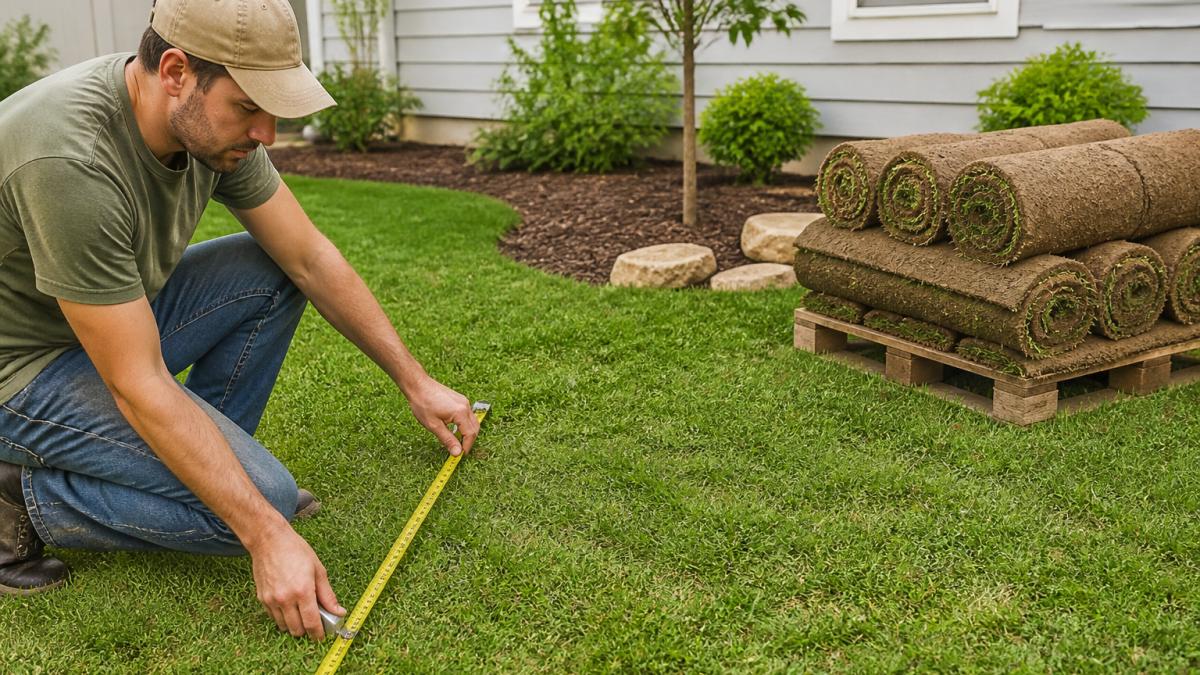
You don't need fancy equipment to measure square footage for sod delivery. A basic measuring tape, pencil, and paper are enough.
Here's what to gather:
- Measuring tape, at least 50 feet long (100 feet is better for large lawns)
- Pencil and notepad, to write down measurements as you take them
- Smartphone, optional but useful for photos and quick calculations
- Straightedge or level, helpful for checking irregular edges
- Graph paper, optional, for sketching your lawn layout
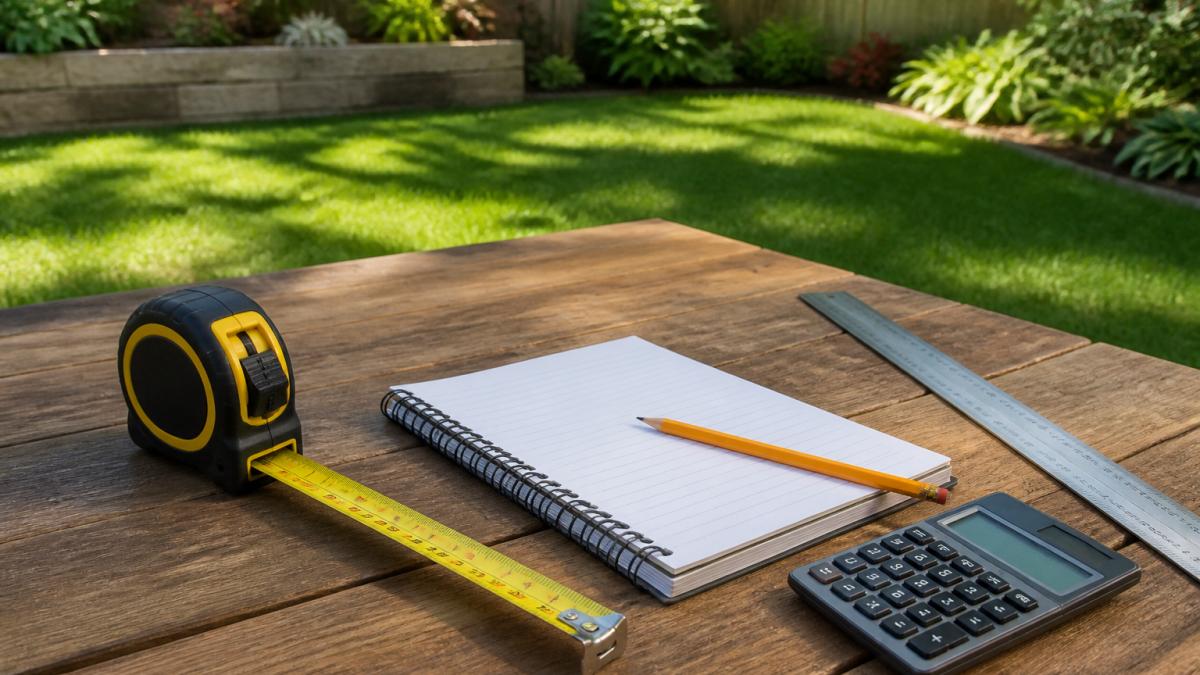
If your lawn is very large or has complex shapes, consider using a smartphone app designed for measuring. Many are free and calculate square footage automatically from photos. However, manual measurement is still the most reliable method.
Having a second person help can speed up the process and reduce errors. One person holds the tape while the other records measurements.
Measuring Square Footage for Regular Rectangular Lawns
For a rectangular lawn, measuring square footage for sod delivery takes just three steps.
Step 1: Measure the length. Start at one corner and run the tape to the opposite corner along the longest edge. Write down the number in feet. Round to the nearest foot.
Step 2: Measure the width. From the same starting corner, measure along the adjacent edge. Record this number too.
Step 3: Multiply length by width. If your lawn is 30 feet long and 20 feet wide, multiply 30 × 20 = 600 square feet.
That's your total. Simple and fast.
However, most lawns aren't perfectly rectangular. They have curves, angles, or irregular edges where the grass meets a patio or driveway. For those areas, you'll need to adjust your approach.
How to Calculate Square Footage of an Irregular Lawn
Irregular lawns require breaking the space into smaller, manageable shapes. This method works for any lawn shape.
Divide your lawn into rectangles and triangles. Look at your lawn and imagine drawing invisible lines to create simple shapes. Most irregular lawns can be split into 2 to 4 rectangles or triangles.
For example, if your lawn is L-shaped, you can divide it into two rectangles. If it has a curved edge, approximate the curve as a triangle.
Measure each section separately. For rectangles, measure length and width, then multiply. For triangles, measure the base and height, multiply them, then divide by 2.
Add all sections together. Once you have the square footage for each shape, add them all up. That's your total lawn area.
Here's a practical example:
- Section 1 (rectangle): 25 feet × 15 feet = 375 square feet
- Section 2 (rectangle): 20 feet × 10 feet = 200 square feet
- Section 3 (triangle): (12 feet × 8 feet) ÷ 2 = 48 square feet
- Total: 375 + 200 + 48 = 623 square feet
This method works well for most residential properties. If your lawn has very curved edges or unusual shapes, sketch it on graph paper first. This helps you visualize the sections before measuring.
Using a Sod Calculator to Confirm Your Measurements
After you've measured manually, use a sod calculator online to double-check your work. Many are free and take just a few minutes.
A sod calculator does the math for you. You enter your measurements, and it calculates total square footage instantly. Some calculators also factor in waste automatically.
Popular sod calculators let you enter multiple sections if your lawn is irregular. You can input each rectangle or triangle separately, and the tool adds them up. This reduces math errors and gives you confidence in your final number.
When you call for a quote, bring both your manual measurements and your calculator results. If they match, you're ready to order. If they differ by more than 50 square feet, remeasure the discrepancy area.
Using a calculator also helps you understand how much sod you actually need. Some homeowners are surprised to learn their lawn is larger or smaller than they thought. A calculator makes that clear before you commit to an order.
How Much Sod to Order: Adding for Cuts and Waste
Your calculated square footage is the starting point, not the final order amount. You need to add extra for cuts and waste.
Sod comes in rectangular pieces. When you install it around curves, corners, and edges, you'll cut pieces to fit. Those cut-off scraps are waste. You can't use them elsewhere, so you need to order extra to compensate.
Industry practice suggests adding 5 to 10 percent extra to your measured square footage. For a 600-square-foot lawn, that means ordering 630 to 660 square feet of sod.
Here's the math:
- Measured area: 600 square feet
- Add 10 percent: 600 × 0.10 = 60 square feet
- Total to order: 600 + 60 = 660 square feet
If your lawn has many curves or complex edges, add 10 percent. If it's mostly straight edges with few cuts, 5 percent is usually enough.
Some homeowners order extra sod as a buffer. A few pallets of extra sod can be stored and used for repairs or patching later. This is smart planning if you have the space to store it temporarily.
When you request a quote, mention your calculated square footage plus the extra percentage. The final order amount can be confirmed based on pallet sizes and your specific lawn layout.
Understanding Sod Coverage Per Pallet
Sod is sold by the pallet, and understanding coverage per pallet helps you know how many pallets to order.
A standard pallet of sod typically covers between 400 and 500 square feet, though this varies by supplier and sod type. Some pallets cover 375 square feet, others cover 600 square feet. Always confirm the coverage with your supplier before ordering.
To calculate how many pallets you need:
- Take your total square footage (including the 5 to 10 percent extra)
- Divide by the coverage per pallet
Example:
- Total square footage needed: 660 square feet
- Coverage per pallet: 450 square feet
- Pallets needed: 660 ÷ 450 = 1.47 pallets
- Order: 2 pallets (round up, never down)
Most suppliers won't sell partial pallets, so you'll always round up. Ordering 2 pallets when you need 1.47 gives you a small buffer, which is fine.
Different sod types have different coverage rates too. Bahia grass, zoysia, and St. Augustine grass each come in different configurations. When you get a quote, confirm the exact coverage per pallet for the sod type you're choosing.
Common Mistakes to Avoid When Measuring for Sod
Even careful homeowners make measurement mistakes. Knowing the most common ones helps you avoid them.
Mistake 1: Measuring only the visible grass. Don't forget areas where sod needs to go but isn't currently grassed. If you're replacing a dead patch or filling in a bare spot, measure that area too. It's part of your total order.
Mistake 2: Forgetting to account for obstacles. Patios, decks, driveways, and garden beds reduce your sod area. Subtract them from your total. Measure around them, not over them.
Mistake 3: Rounding down instead of up. If your calculation gives you 1.3 pallets, order 2. Rounding down leaves you short. Rounding up gives you a small safety margin.
Mistake 4: Using old measurements. If you measured your lawn a year ago, remeasure. Landscaping changes, and your notes might be incomplete or inaccurate.
Mistake 5: Not confirming pallet coverage. Assuming all sod pallets cover the same square footage is a common error. Coverage varies. Ask your supplier every time.
Mistake 6: Measuring alone. A second person catches mistakes. One person holds the tape while the other reads and records. It's faster and more accurate.
Mistake 7: Ignoring slopes and uneven ground. If your lawn is on a slope, measure along the ground, not horizontally. Uneven terrain adds extra square footage to your measurement.
Many of these mistakes are easy to fix with a quick double-check. Before you place your order, review your measurements one more time. Ask a neighbor or friend to verify your numbers. The few minutes you spend double-checking save money and headaches later.
Getting your how to measure square footage for sod delivery right is the foundation of a successful sod installation. Accurate measurements mean you order the right amount, avoid delays, and stay on budget. When you're ready to move forward, P&P Landscaping and Tree Service is here to help. Book an on-site estimate now and let our team confirm your measurements and deliver the lush, healthy lawn you've been planning.
Frequently Asked Questions
What's the best way to measure my yard for sod delivery?
Start by dividing your lawn into simple shapes (rectangles, triangles, circles). Measure the length and width of each section with a measuring tape, then calculate the area using basic geometry formulas. For rectangular areas, multiply length by width. For triangles, multiply base by height and divide by two. Add all sections together for total square footage. If your lawn has curves or irregular edges, break it into manageable sections or use the grid method by dividing your yard into 10-foot squares.
How do I calculate square footage of an irregular lawn accurately?
Divide irregular shapes into smaller, manageable sections that you can measure individually. Use the grid method by imagining your lawn divided into 10-foot squares, then measuring the dimensions of each square. Alternatively, sketch your lawn on graph paper and count squares to estimate total area. For curved edges, measure the diameter of curved sections and use the circle formula (radius squared times 3.14). Add all individual measurements together. When in doubt, round up slightly to account for waste and ensure you have enough sod.
How much extra sod should I order for cuts and waste?
Order an additional 5-10% beyond your calculated square footage to account for cuts, mistakes, and settling. For example, if your lawn is 2,000 square feet, order enough sod for 2,100-2,200 square feet. This buffer prevents shortages when pieces need to be trimmed to fit edges, curves, or around obstacles like trees and flower beds. Excess sod can be stored in a shaded area if kept moist, or you can use it for repairs after installation settles.
How many square feet does one pallet of sod cover?
Most standard sod pallets cover 450-500 square feet, though this varies by supplier and sod type. Each pallet typically contains 50-60 rolls, with each roll measuring about 10 feet long by 16 inches wide (roughly 10-12 square feet per roll). Always confirm the exact coverage with your sod supplier before ordering, as dimensions can differ. Knowing your pallet coverage helps you determine how many pallets you need based on your total square footage calculation.